Dodgers' Denial of Federal Agents Sparks Corporate America’s Political Awakening
- Jun 21, 2025
- 3 min read
21 June 2025
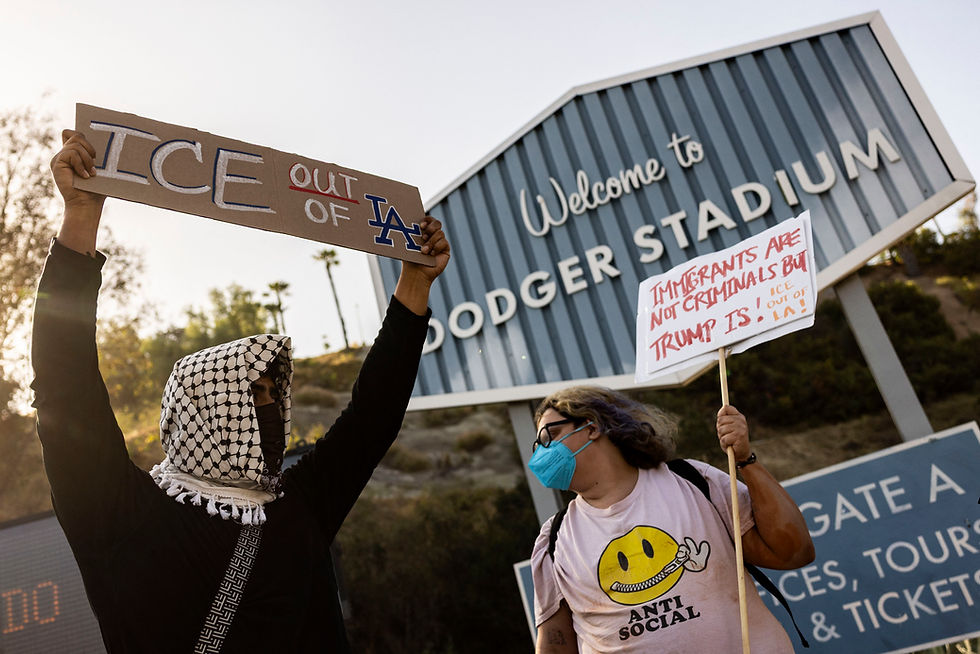
Dodger Stadium became ground zero for a powerful convergence of sports, civic values, and brand management on June 19 when the Los Angeles Dodgers refused entry to federal immigration enforcement agents at their parking facilities. Although DHS later clarified that Customs and Border Protection officials not ICE, were at the scene for unrelated purposes, the incident triggered a dramatic shift in how businesses, especially sports franchises, engage with American politics.
From a business magazine perspective, the Dodgers’ response can be viewed through three strategic lenses: brand positioning, stakeholder impact, and operational risk management.
First, brand positioning. The Dodgers serve a deeply diverse fan base, with Latino communities comprising a significant portion of ticket holders and regional loyalty. Against a backdrop of heightened immigration raids in Los Angeles marked by protests and federal National Guard deployments, the club’s denial of agent access was a calculated cultural alignment with district sentiment. By publicly drawing a boundary, the Dodgers reinforced their image as more than an entertainment product they are civic institutions reflective of their city’s values.
Stakeholder impact, meanwhile, rippled across investors, fans, and local government. Investors face a classic reputational calculus: will the stance alienate politically opposed consumers or enhance loyalty among progressive communities? For fans, especially within immigrant-rich neighborhoods, the stance offered reassurance amid widespread uncertainty . The team swiftly committed $1 million toward immigration-related legal aid, signalling that the statement wasn’t mere first-day optics, but a sustained effort.
Operationally, the incident escalated risk management factors. The presence of armed federal agents outside the stadium even briefly raises safety protocols and liability concerns. The Dodgers coordinated with LAPD to prevent escalation and ensure player and fan security . Sports enterprises increasingly must integrate non-traditional risks such as political protests and federal enforcement presence into event planning and insurance coverage.
The Dodgers’ decision mirrors broader cultural dynamics in the NFL, NBA, and beyond, where teams are expected to take stands on pressing social issues. But baseball’s historical reluctance toward political alignment made this move stand out. The Dodgers, an organization synonymous with diversity since Jackie Robinson, have leveraged both legacy and demographics to frame their choice as an extension of civic identity.
The ripple effect extended further: Angel City FC, backed by Disney CEO Bob Iger and his wife, also took a public stand, issuing bilingual solidarity messages and distributing 10,000 “Immigrant City FC” T-shirts. Corporate America’s interactions with politics are evolving from reactive responses to calculated positioning. Sports franchises with large and diverse fanbases are now anchoring brand equity in cultural stances that resonate with stakeholders beyond ticket sales.
The Dodgers’ early support earlier in June included a delay in planned community messaging and a decision to allow Nezza’s Spanish national anthem performance, moments that fed a narrative about identity and inclusion.
Yet, making a social statement is fraught with challenge. Conservative critics accused the Dodgers of impeding federal operations, questioning whether sports venues should become political flashpoints. The legal ambiguity, ICE denies requesting access while DHS states CBP was present further muddies the optics. But perhaps the more significant consequence lies in fan perception and subsequent loyalty.
By basing its stance on shared values rather than partisan signaling, the Dodgers elevated brand authenticity. That credibility, backed by immediate financial follow-through, may well resonate long after the dust settles.
America’s corporate landscape is in transition. From stadiums to boardrooms, organizations are navigating the blurred lines between cultural relevance and political neutrality. The Dodgers’ decision marks a tactical inflection point: they transformed a security scenario into a statement, positioning themselves not just as entertainers, but as participants in civic life.
In doing so, they’ve set a precedent. As social issues increasingly intertwine with brand purpose, being reactive may no longer suffice. In 2025, market favor may go to businesses that anticipate the intersection of policy and public sentiment and act swiftly when they align.
For now, the question isn’t whether brands should speak out, it’s whether they can do so deftly, credibly, and with consistency. The Dodgers showed one model. The true test will be whether corporate America can follow that playbook without losing its at-bat.


Comments